
In much of the world, especially in countries like India, two-wheelers are not just a mode of transport—they are essential lifelines. Scooters and motorcycles account for over 70% of all vehicles on the road, carrying students, workers, delivery personnel, and families through bustling cities and narrow by lanes. Yet despite their dominance in everyday mobility, they remain largely invisible in global transportation research. While billions are invested in autonomous cars, the challenges and safety needs of two-wheeler riders have been overlooked for far too long.
Recognizing this critical gap, researchers at IIIT Hyderabad, with support from iHub-Data, have launched a pioneering initiative to bring data-driven intelligence to two-wheeler mobility. The project introduces an AI-powered system called ATID—designed not for luxury or high-end adoption, but for accessible, real-world impact. Central to the effort is a rich, high-fidelity dataset titled “Two-Wheeler Safety Quantification through Risk & Attitude Factors Using Multi-Sensory Integration,” aimed at capturing the complex, real-world dynamics of two-wheeler riding.
What sets this work apart is its attention to the unique vulnerabilities of two-wheelers. Unlike cars, these vehicles are highly sensitive to road conditions, weather, and traffic behaviour. Riders navigate with less protection, greater physical agility, and a higher risk profile. To truly understand and improve safety, one must capture data not in the lab, but on the street—where actual behaviour, obstacles, and decisions play out in real time.
To do this, the team retrofitted a standard electric scooter—chosen for its vibration-free drivetrain—with a full suite of cameras, GPS, inertial sensors, and weatherproof computing hardware. This mobile lab captures 360-degree video, motion dynamics, road surface conditions, and the nuanced interplay between rider decisions and environmental stimuli. From sudden braking to sharp turns and evasive manoeuvres, every ride generates a synchronized dataset that tells a detailed story of risk, responsiveness, and context.
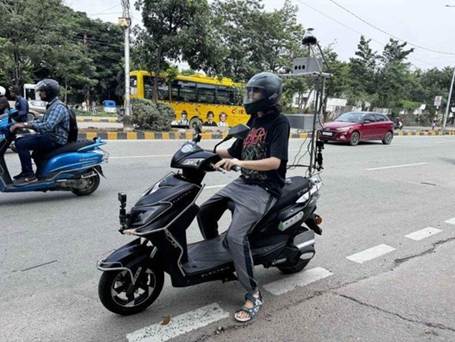
Two-Wheeler Data Collection Platform
But this isn’t just about collecting data. It’s about enabling tangible impact. The dataset supports the development of advanced safety systems tailored for two-wheelers—collision alerts, blind spot detection, and real-time risk analysis tools that were previously only feasible in four-wheelers. It also holds potential for improving urban infrastructure, informing city planners where road surfaces degrade or traffic patterns endanger riders. For the AI community, it serves as a benchmark for training models in perception, scene understanding, and behaviour prediction in dense traffic environments.
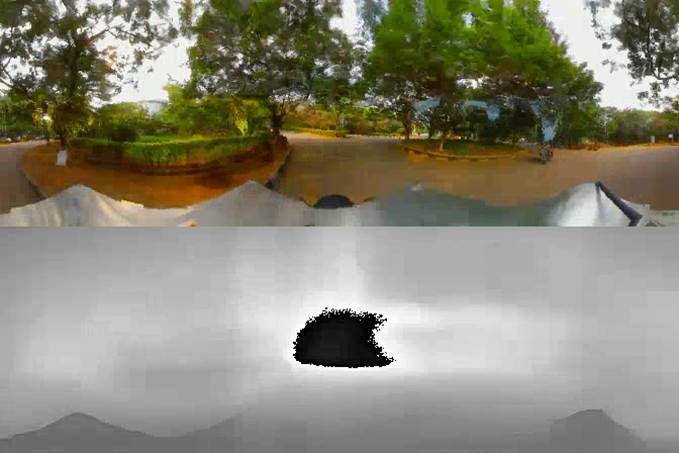
Real-Time 3D Depth Map from 360-degree camera
At its core, this initiative is not about technology for its own sake. It’s about building a safer future for the millions who rely on two wheels for their livelihoods and daily lives. Every data point corresponds to a real person—often without the option of safer, more expensive transport alternatives. By making the tools, methods, and insights from this research open and accessible, the team at IIIT Hyderabad is not just advancing science—they are levelling the playing field for mobility.
As the project scales to new routes, terrains, and conditions, it moves us closer to a world where two-wheeler safety is no longer an afterthought. In the evolution of intelligent mobility, this work ensures that two wheels ride alongside four—not behind them.
To explore/download the dataset and learn more about the dataset, please visit:
Program Head
Prof. Aftab M Hussain, Associate Professor, IIIT Hyderabad
Email: aftab.hussain@iiit.ac.in
Website URL: https://www.iiit.ac.in/faculty/~aftab.hussain
Publisher
Rahul Kumar, IHUB-Data
LinkedIn URL: Rahul Kumar